
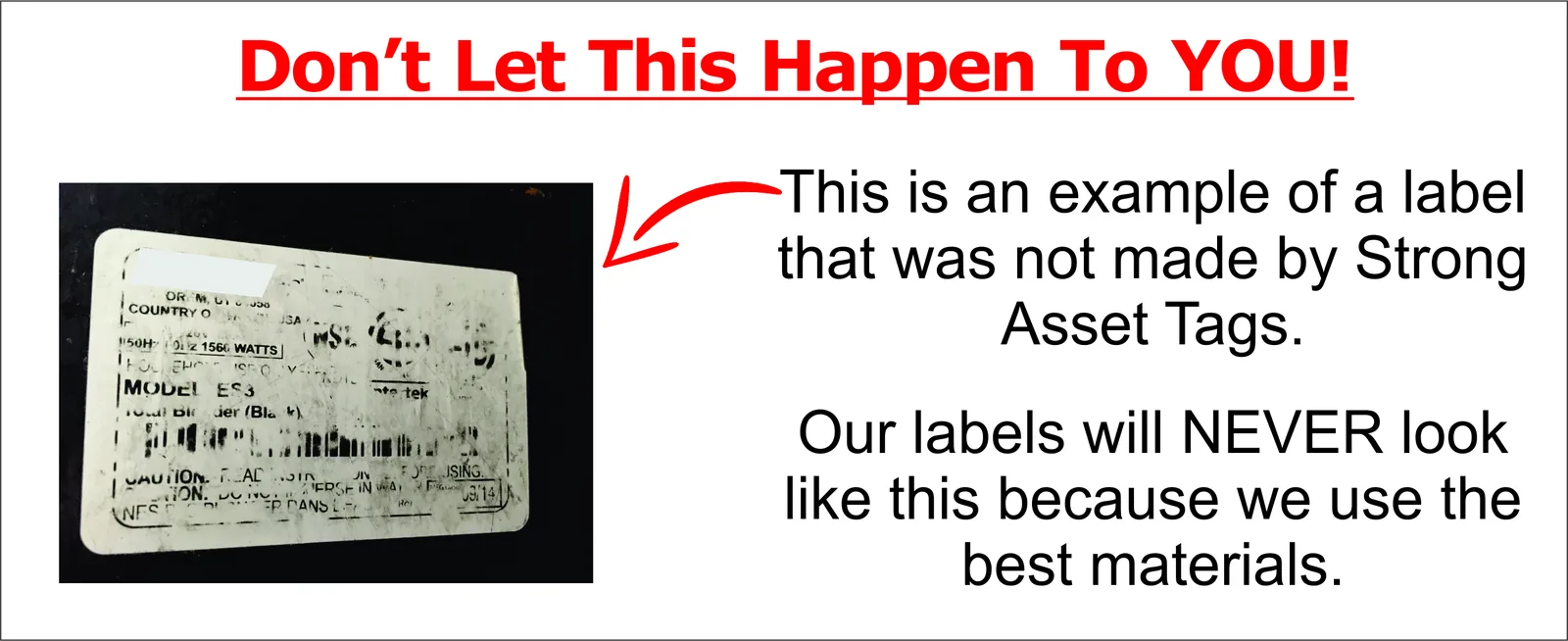
Asset tags fall off for two main reasons: the adhesive does not match the surface, or the surface was not clean and dry when the tag went on. The other four causes are heat past the tag's rating, strong solvents, sun on print with no overlaminate, and abrasion on a label too thin for the job. Each one has a fix, and almost every fix is decided before you order. Our Hall of Shame collects real failures we were asked to replace. Below are the six causes, what each one looks like on the asset, how to prevent it, and which of our three tiers fits.
1. The adhesive does not match the surface
Powdercoat, polyethylene, polypropylene and rough cast metal are low-surface-energy surfaces. They repel standard adhesives, and a lot of equipment is finished in exactly those. One oilfield operator in our Hall of Shame tagged powdercoated assets with a typical label that used a standard acrylic adhesive. The tags fell off within 30 days. To prevent it, test the surface before you choose a tag. Put a drop of water on it. If the drop beads up instead of spreading out, the surface is low-surface-energy. The fit is the Strongest tier. Its 3.5-mil permanent adhesive uses a high-tack acrylic chemistry rated for low-surface-energy surfaces, and the 12-mil plastic backing gives it enough mass to fully wet out a textured finish. The Stronger tier bonds to most smooth or lightly textured surfaces. The Strong tier is for smooth surfaces only.
2. The surface was dirty, wet or cold
Most labels that fall off were applied to a dirty surface. Grease, oil, dust and cleaning residue sit between the adhesive and the asset, so the tag bonds to the dirt instead of the surface. A damp surface causes the same problem. To prevent it, clean the spot first. Greasy or dirty equipment should be cleaned with a hot solvent like lacquer thinner, and the surface should dry completely before the tag goes on. Cold is the third part of this cause. Our permanent adhesive applies and bonds reliably down to a -10°F install temperature, so a cold yard or a cold shop is not a problem for it. The Strong tier is different: it needs a smooth, clean, dry, room-temperature surface. For installs in the cold, choose the Strongest tier. Every sample pack includes an instruction card for surface prep.
3. Heat beyond the rating
A surface that runs hotter than a tag's rating will beat even a well-applied tag. Stronger and Strongest tags are rated for -40°F to 250°F continuous service. Continuous heat above 250°F and direct flame defeat any printed label, ours included. To prevent it, put the tag on the cool side of the equipment: a side or front panel away from the heat source, the area near the controls, or the frame. Keep tags away from direct flame and from surfaces that run above ambient temperature. The fit is Stronger or Strongest, placed away from the heat. If a surface runs above 250°F, contact us about specialty constructions.
4. Solvents and harsh chemicals
A tag can keep its grip and still be lost to chemicals, because print that sits on top of a label with no protective layer can be wiped or scrubbed away. On the Stronger and Strongest tiers, the print sits under a clear overlaminate rated against isopropyl alcohol, ethanol and quaternary-ammonium disinfectants. It resists bleach and chemical splash. On production equipment, Strongest tags survive parts-washer cycles below 180°F with a standard industrial degreaser. The limit is sustained soaking in solvents stronger than a standard industrial degreaser, which will defeat any printed label. To prevent chemical failures, place tags away from splash zones where you can, and test a sample with the cleaner or degreaser your team actually uses. The fit is Strongest for coolant, solvent and degreaser, and Stronger for surfaces that are wiped down with disinfectant.
5. Sun on print with no overlaminate
UV rarely pulls a tag off. It does something just as bad: it fades the print until the number and the barcode cannot be read, and a tag nobody can read has failed as surely as one lying on the floor. Without overlaminate, even premium ink fades under sustained outdoor exposure. In our Hall of Shame, a construction-fleet operator tagged 200 pieces of equipment with thin polyester labels. By month six, half of them were unreadable, because direct sun and hydraulic-fluid splash had bleached the print. The replacement Strongest tags were all still scanning five years later. To prevent it, match the tier to the time outdoors. The Strong tier has no overlaminate and is rated 2 years outdoors. The Stronger tier seals the print under a 3-mil clear overlaminate and is rated 2 to 5 years outdoors. The Strongest tier uses a 6-mil overlaminate and is rated 5+ years outdoors. Every environment is different, with its own mix of UV and contaminants, so no tag's lifespan is guaranteed. Our weatherproof labels page covers outdoor assets.
6. Abrasion and impact on a thin label
Tools, boots, carts, students and cleaning brushes all wear on a tag, and a thin label tears or gets scraped away. A school district in our Hall of Shame bought metal-look aluminum-foil tags, and kids peeled them off Chromebook lids within weeks. To prevent it, think about thickness and placement. The 12-mil plastic core of the Strongest tier absorbs impact that destroys thinner labels, and its overlaminate resists scraping and gouging. Our most punishing field test put a Strongest tag on the steel tread of a bulldozer, and it survived. Placement helps every tier: choose a flat or gently curved area that does not take direct hits or rub against other parts. On laptops, use the lid corner, not the palm rest. The fit is Strongest for equipment that gets hit, dragged or thrown in a truck bed. Stronger vinyl with overlaminate replaced the foil tags in that school district, with three school years and no failures.
Choose the tag before you order, not after it fails
The six causes come down to three questions: what surface, what environment, and how long the tag has to last. The spec builder asks about your environment, surface, format and size, then gives you the tier and the price. For field equipment, our guide to permanent labels for equipment covers adhesives and surface prep in more detail. Then test. Order samples and we ship all three tiers in several sizes. Put one where the real tag will go, prepare the surface the way the instruction card shows, and try to make it fail: pull on a corner, scrape it, wash it with your own cleaner, and leave one in the harshest spot you have.