
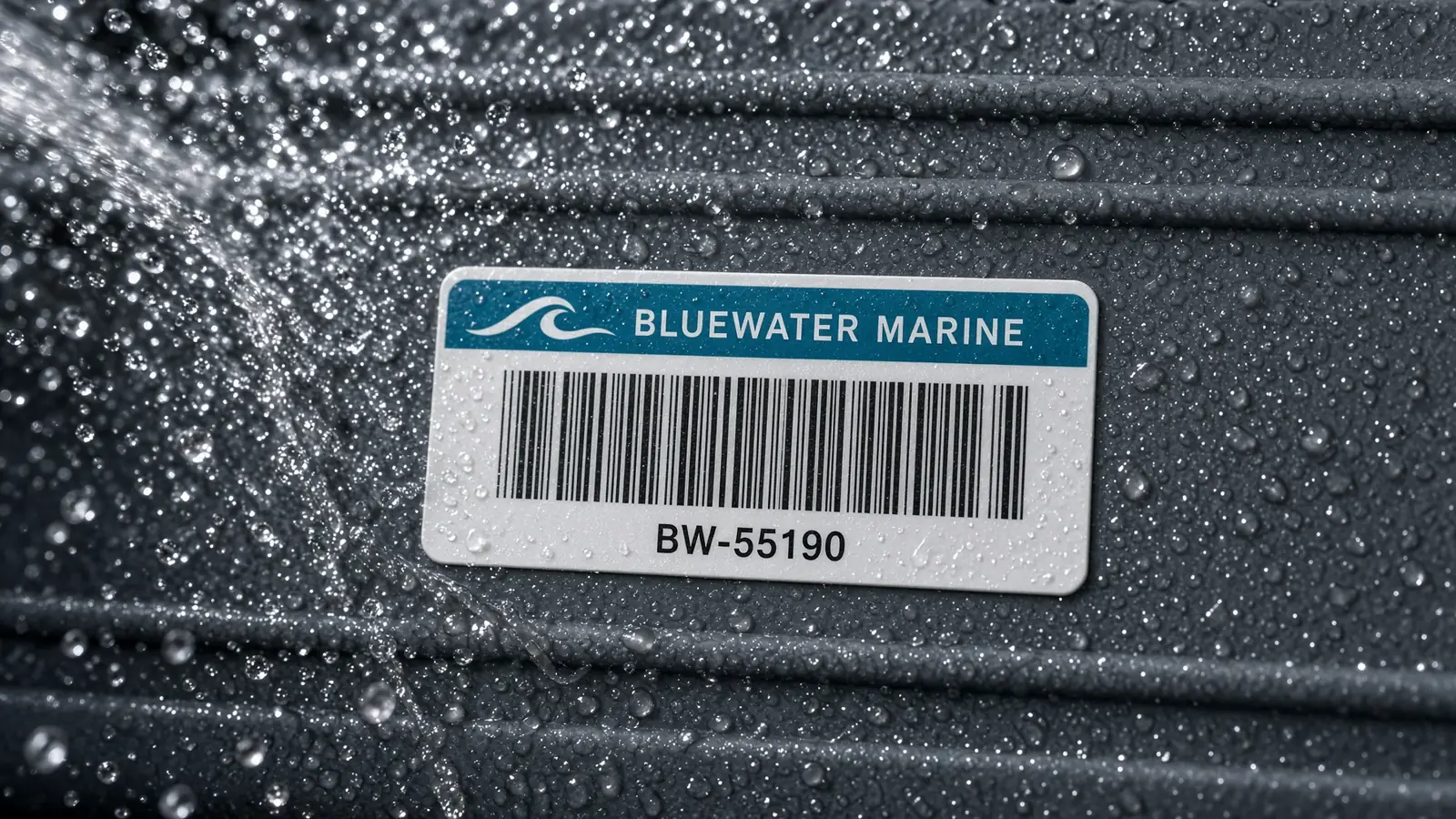
Asset tags that survive pressure washing and daily wash-downs have two things in common: the print is sealed under an overlaminate, and the adhesive is matched to the surface. Our Stronger and Strongest tiers are built that way and are waterproof under standard industrial washdown, and for equipment that gets hosed down every day we recommend the Strongest tier. Our published rating is for standard industrial washdown, not for a pressure washer up close, so read the limits below and test a sample with your own washer before you tag everything.
What a wash-down does to a label
Water on its own is rarely the whole problem. It is everything that comes with it: degreaser on the line, sanitizer on every surface, hot water, a scrub brush, and in some plants a hose aimed straight at the machine. A label with ink on its surface gets scrubbed blank. A label with a general-purpose adhesive on a surface it was not made for lets go. A wet barcode is a destroyed barcode if the print is not sealed, so that is the first thing to check on any tag you plan to wash.
What waterproof means on our tags
On the Stronger tier, full-color print sits under a 3-mil clear overlaminate on 5-mil vinyl. On the Strongest tier, it sits under a 6-mil textured overlaminate on 12-mil plastic. Both are waterproof under standard industrial washdown, and both keep the barcode legible through rain and short-term submersion. Submersion is where they differ. Stronger handles short-term submersion of less than 24 hours without delamination. Strongest handles indefinite submersion in fresh or salt water, provided the asset itself is water-stable. The Strong tier has no overlaminate. Its thermal-transfer print is fused into 2-mil polyester, and it is made for smooth, clean indoor surfaces like office IT and lab equipment. It is not the tag for a wash-down area.
Pressure washing: what we can and cannot promise
Our rating is for standard industrial washdown. We do not publish a separate rating for a pressure washer held close to a tag, and we will not make one up. Nozzles, pressure, distance and water temperature change from one site to the next, so the honest answer is to test. What helps most is a Strongest tag on a clean surface with a full adhesive bond, placed out of the direct line of spray. Then wash a sample the way your crew actually washes, and look at it after a week of real use.
Chemicals in the wash
The Stronger and Strongest overlaminate is rated against isopropyl alcohol, ethanol and quaternary-ammonium disinfectants, and it resists bleach. On production equipment, Strongest tags survive parts-washer cycles below 180°F with a standard industrial degreaser. For caustic or hot-acid washdowns, contact us about specialty constructions.
The limits
Three things defeat any printed label, ours included: continuous heat above 250°F, direct flame, and sustained soaking in solvents stronger than a standard industrial degreaser. Stronger and Strongest tags are rated for -40°F to 250°F continuous service, which covers walk-in coolers and freezers as well as equipment housings that stay warm but never get hot. If a surface runs hotter than that, or the asset sits in a solvent bath, a printed label is the wrong choice.
Which tier for a wash-down area
Choose the Strongest tier for equipment that is washed down or hosed, or that sees coolant, solvent or degreaser. Our spec builder recommends it for any indoor industrial environment with washdown, coolant or solvent. It is also the only tier for powdercoat, textured plastic, polyethylene and polypropylene, which are common finishes on washed equipment and plastic bins. Choose the Stronger tier for smooth surfaces that are wiped and sprayed with cleaner rather than hosed, like gym equipment and POS terminals. It carries a full-color logo and can be removed from hard surfaces without leaving permanent residue when the asset is retired. If the code has to survive scrubbing, consider Data Matrix: its error correction reads through partial damage where a 1D barcode fails.
Placement: keep the tag out of the line of fire
Where the tag sits matters as much as what it is made of. Put it out of the direct line of spray when the equipment allows it: a side panel, the frame, or the area near the controls rather than the surface the crew aims at. Choose a flat or gently curved area that does not take direct hits or rub against other parts. In a kitchen, keep tags off food-contact surfaces and on the cool side of the equipment, away from burners, griddles, fryer vats and oven doors.
Install it so the water has nothing to work with
A wash-down finds every weak bond. Clean the spot first: greasy or dirty equipment should be cleaned with a hot solvent like lacquer thinner. Let the surface dry completely before the tag goes on, and apply it between washes, not during one. Our permanent adhesive applies and bonds reliably down to a -10°F install temperature, so a cold plant is not a problem. Every sample pack includes an instruction card for surface prep.
Kitchens and gyms: two kinds of daily wash-down
A restaurant kitchen is scrubbed down at close: degreaser on the line, sanitizer on every prep surface, then hot water and a scrub brush. Our page on restaurant asset tags covers the back of house, smallwares and POS gear. For smallwares that go through a dish machine, test before you commit. A gym gets wiped down many times a day, with cleaner from a spray bottle or a wipe. Our page on gym equipment tags covers consoles, racks and benches. Our tags are on assets at Chick-fil-A and Planet Fitness.
Test it with your own washer
Do not take a durability rating on faith, ours included. Order samples and we ship all three tiers in several sizes within one business day. Put a sample where the real tag will go. Wash it with the cleaner or degreaser your team uses, the way they use it. Scan it with the scanner or phone your team will actually use. Leave one in the harshest spot you have and check it again later. For the full range of wet-area labels, see waterproof barcode labels, and for assets that also live outdoors, weatherproof labels.